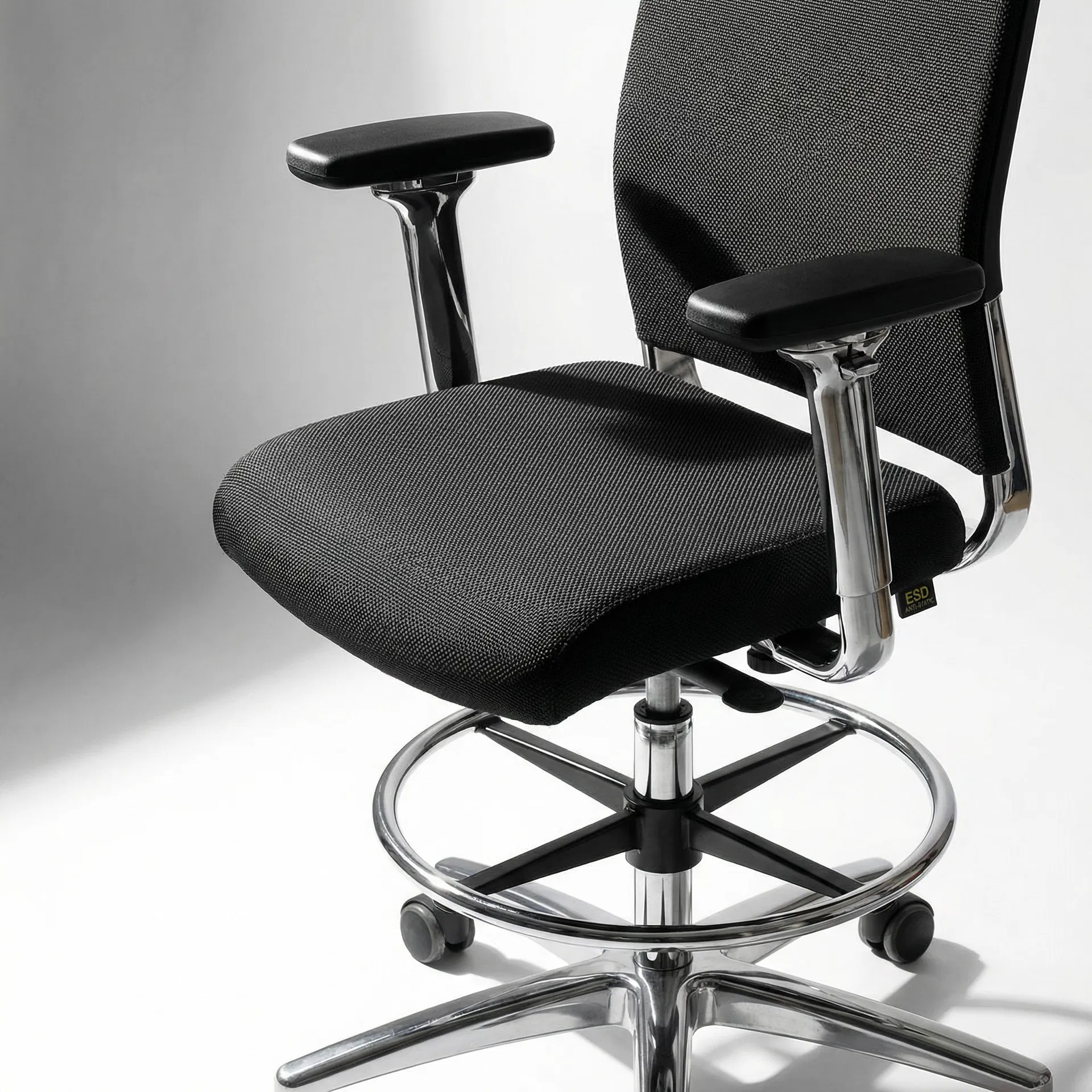
Introduction: The Invisible Threat in Electronics Manufacturing
In modern electronics manufacturing, one of the most persistent and costly threats is completely invisible to the human eye. Electrostatic discharge (ESD) — the sudden flow of electricity between two electrically charged objects — can destroy sensitive electronic components in milliseconds, often without any visible sign of damage. A single ESD event can render a microprocessor, memory chip, or integrated circuit permanently defective, resulting in costly rework, warranty returns, and customer dissatisfaction.
The human body is one of the most common sources of ESD in manufacturing environments. A person walking across a vinyl floor can generate up to 12,000 volts of static electricity. Sitting down on a standard chair can generate 1,500–3,000 volts. While these voltages are far below the human perception threshold (approximately 3,000 volts), they are more than sufficient to damage sensitive electronic components, many of which can be damaged by discharges as low as 10–100 volts.
This is where ESD anti-static chairs become a critical component of any electronics manufacturing environment. An ESD chair is specifically designed to safely dissipate static electricity from the human body to ground, preventing the accumulation of charge that leads to damaging ESD events.
What Makes a Chair "ESD Safe"?
Not all chairs marketed as "ESD" or "anti-static" provide genuine protection. A true ESD-safe chair must meet specific resistance requirements defined by international standards, primarily IEC 61340-5-1 (the international standard for ESD protection in electronics manufacturing) and its European equivalent EN 61340-5-1.
According to these standards, an ESD chair must provide a controlled path for static electricity to dissipate from the user to ground. This path runs from the user's body, through the chair's upholstery, down the chair's frame and base, through the casters, and to the floor (which must also be ESD-conductive or have ESD floor mats). The resistance of this entire path must be carefully controlled — not too high (which would prevent dissipation) and not too low (which could create a shock hazard).
The key resistance specifications for ESD chairs are:
- Upholstery surface resistance: 10⁶ to 10⁹ Ω (dissipative range)
- Chair-to-ground resistance: Less than 3.5 × 10⁷ Ω (per IEC 61340-5-1)
- Caster resistance: Conductive or dissipative to ensure continuity to floor
A chair that simply uses "anti-static" fabric without a conductive base and casters does not provide a complete grounding path and should not be considered a true ESD chair. TuoFu's ESD chairs are designed as complete systems, with every component — upholstery, frame, base, and casters — contributing to the grounding path.
Technical Explanation: How ESD Chairs Work
Understanding the physics of ESD protection helps explain why every component of an ESD chair matters. Static electricity is generated through triboelectric charging — the transfer of electrons when two materials come into contact and then separate. When a person sits in a chair, their clothing and the chair's upholstery exchange electrons, creating a charge differential.
In a standard chair with non-conductive upholstery, this charge accumulates on the person's body with no path to ground. When the person then touches a sensitive electronic component or PCB, the accumulated charge discharges rapidly through the component — potentially destroying it.
An ESD chair prevents this by providing a continuous, controlled resistance path from the user to ground. The conductive or dissipative upholstery allows charge to flow from the user's body into the chair. The conductive frame and base continue this path downward. The ESD casters (which have conductive or dissipative rubber compounds) transfer the charge to the ESD floor or floor mat, which is connected to the facility's grounding system.
The resistance values are carefully chosen to balance two requirements: the resistance must be low enough to allow static charges to dissipate before they reach damaging levels, but high enough to prevent a dangerous shock if the user accidentally contacts a live electrical circuit. The 10⁶–10⁹ Ω dissipative range achieves this balance.
Buying Advice: Selecting ESD Chairs for Your Facility
When purchasing ESD chairs for an electronics manufacturing environment, consider the following factors:
1. Verify Certification Documentation
Always request IEC 61340-5-1 test reports from the manufacturer. These reports should show measured resistance values for the upholstery, base, and complete chair-to-ground path. Be wary of suppliers who claim ESD compliance without providing test documentation.
2. Consider the Complete EPA System
ESD chairs work as part of a complete Electrostatic Protected Area (EPA) system. Ensure your facility also has ESD flooring or floor mats, ESD wrist straps for operators, and proper grounding connections. An ESD chair used on non-conductive flooring provides limited protection.
3. Match Chair Type to Application
Different electronics manufacturing applications have different requirements. PCB assembly may require chairs with armrests to reduce operator fatigue. Inspection stations may need height-adjustable chairs to match microscope or inspection equipment heights. Cleanroom electronics manufacturing requires chairs that also meet particle generation requirements.
4. Evaluate Upholstery Options
ESD chairs are available with different upholstery materials. ESD vinyl (PVC) is the most common, offering easy cleaning, chemical resistance, and reliable ESD properties. ESD fabric provides better comfort for long shifts but may be harder to clean. For cleanroom applications, ESD vinyl is typically preferred due to its low particle generation.
Conclusion
ESD anti-static chairs are not a luxury — they are a necessary investment for any electronics manufacturing facility that handles sensitive components. The cost of a quality ESD chair is minimal compared to the cost of a single ESD-damaged component or the liability of shipping defective products to customers.
TuoFu Industrial Seating manufactures IEC 61340-5-1 compliant ESD chairs with full test documentation. Our ESD chairs are used in electronics manufacturing facilities across Asia, Europe, and North America. Contact our technical sales team to discuss your specific ESD protection requirements.
Ready to Source Industrial Chairs?
Contact TuoFu Industrial Seating for pricing, samples, and OEM capabilities. Our export team responds within 24 hours.
Get a Free Quote